Retaining Wall Drainage Correction in Green Bay, WI
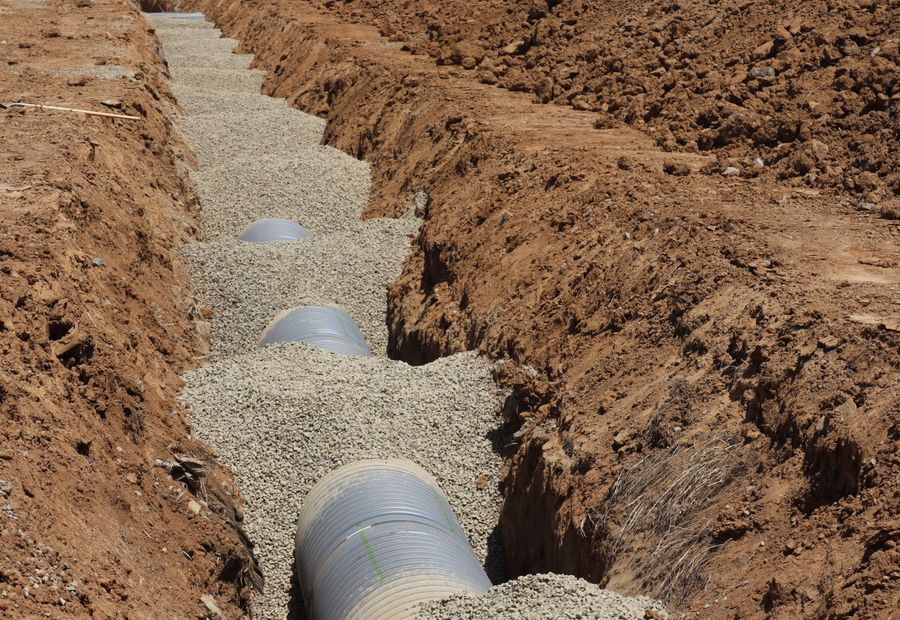
Green Bay Retaining Walls corrects the drainage behind retaining walls for homeowners in Green Bay, De Pere, Allouez, Bellevue, Ashwaubenon, Howard, and throughout Brown County, Wisconsin. This is the job for a wall that is still sound and still soaking: the face is straight, the base is solid, and water is the only thing wrong with it.
Four parts make the repair, and skipping any one of them wastes the other three. Washed angular stone takes the place of the dirt backfill against the wall, from the base course up to within a few inches of the top. Non-woven filter fabric wraps the line between that stone and the native soil, because red clay migrates into open stone with every storm and a silted column drains nothing at all. A perforated pipe in a fabric sock lies along the bottom of that stone and falls steadily to an open end. Surface water gets intercepted before it ever reaches the fill. What that replaces is the usual arrangement, a few holes punched through the face and clay rammed in everywhere else.
Frost Is the Local Argument
Rain is the obvious case for a stone column. Winter is the stronger one. Frost reaches close to four feet down in this county, which is deeper than most yard walls are tall, so the freeze takes the whole backfill and not just the top of it. Water held in red clay expands when it turns, and it shoves the wall out a fraction each time. Open stone drains before it can freeze into one solid block, so the wall carries soil load and nothing else.
Water Arriving From Above
Half of what soaks a wall never travelled through the ground. It ran across it. A lawn pitched toward the top of the wall, a patio shedding the wrong way, a roof line dumping into the bank, a driveway funnelling every storm into one corner. We cut a swale, set a surface inlet, or extend a discharge line so that water goes around the wall instead of into it.
Snowmelt and Blocked Outlets
Plenty of walls already have a pipe, and the pipe ends under sod, inside a mulch bed, or crushed flat by a machine tire. A buried outlet at the bottom of a slope also freezes shut in January and stays shut into March, which is exactly when the snowpack releases and the wall needs it most. We locate the end, open it, and reset it where you can see it and check it yourself.
Booking
Saturated spring ground shows us where the water travels, so spring is the right time to look and the wrong time to dig. We plan the digging around it. (920) 555-0187 gets an assessment on the calendar.
Can drainage be fixed without pulling the wall apart?
Part of it, sometimes. Water arriving over the top gets stopped at the surface with a swale, a trench drain, or a downspout run past the wall, and none of that touches a single unit. Water already sitting inside the fill is another matter, and reaching it means opening the back. On a dry-stacked block wall we can often pull the top courses only, work from there, and reset them. Where there is no stone column at all, the run comes down.
Are weep holes any good?
They release the water that happens to reach them, and nothing else. A weep does nothing about water sitting three feet back in the middle of the fill, and it silts up or roots over in a few seasons. Weeps make sense on a poured or mortared wall as one piece of a plan that also has stone and a pipe behind it. They are not a substitute for either of those.
Where is the pipe supposed to come out?
Somewhere lower than the pipe, in the open, where water leaves under its own weight. The end gets a rodent grate and stays clear of sod and mulch. A pipe that dead-ends inside the backfill collects water rather than removing it, and the wall ends up worse off than it would be with no pipe. Where the grade gives us nothing to fall toward, the line ends in a sump or a pop-up set in a low corner.
Could my downspout be soaking the wall?
It happens constantly. A downspout emptying above or behind a retaining wall drops an entire roof into the backfill, storm after storm, from April to November. We carry it past the wall in solid pipe and out to daylight. The same treatment goes to a sump discharge, a driveway shedding toward the wall, and a neighbor's grade running downhill into your slope.