Boulder & Natural Stone Retaining Walls in Green Bay, WI
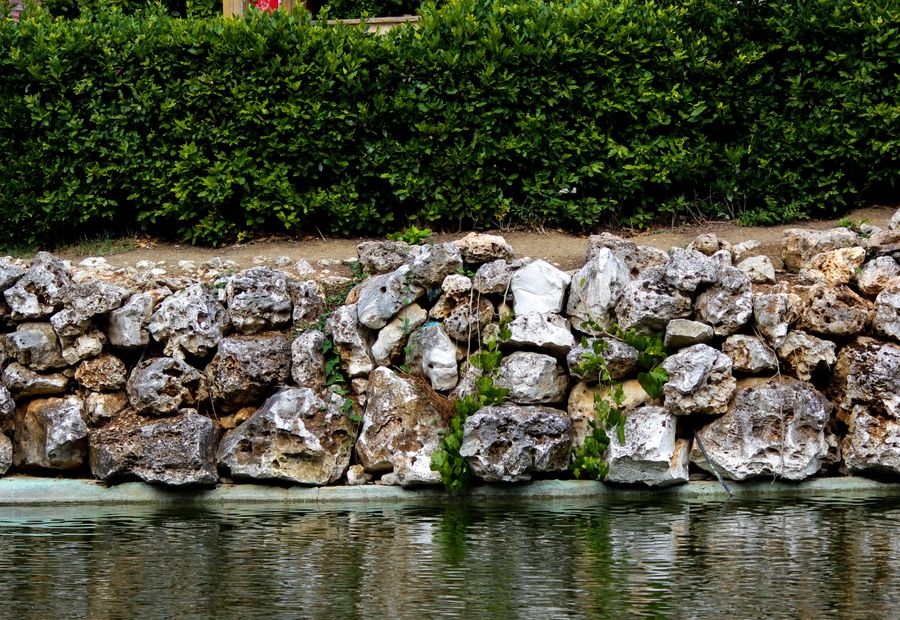
Green Bay Retaining Walls builds boulder and natural stone retaining walls for sloped yards, creek and pond banks, driveway cuts, and garden terraces in Green Bay, De Pere, Ledgeview, Howard, Suamico, and across Brown County, Wisconsin. As a landscaper and wall builder we set outcropping dolomite, quarried wall stone, and glacial fieldstone, dry-laid or mortared.
Dolomite is the working stone in this market for an obvious reason. The Niagara Escarpment, which everybody here calls the Ledge, runs along the east side of the metro, and Ledgeview sits right on it. Fonferek's Glen shows the same rock in a cliff face and a waterfall a few miles from town. Big stone gets placed one piece at a time with a machine and a thumb, and each one gets turned until it beds on two points of the stone beneath it instead of rocking on one. The base course goes into a trench below finish grade so the toe is locked before the wall climbs. Behind all of it sits washed angular stone, filter fabric, and a pipe on a fall. A wall rolled into place on top of the sod with clay tucked in behind has no toe and no outlet, and four feet of frost finds both faults in a couple of winters.
Gravity Does the Work
There is no grid in a boulder wall and no pin between stones. Weight holds the hill, plus the batter that steps each course back into the slope. That is why the size of the stone matters more than the shape of it, and why small rock stacked high fails on ground where the same face in large rock stands for good.
Dry-Laid Work
Flat quarried stone goes down in courses with the joints staggered and the face pitched slightly back. Chinking stone fills where a piece needs bearing rather than where a gap needs hiding. Every stone lands on two below it. Nothing floats on soil and nothing carries its load on a single point.
Why Stone Bellies Where Block Leans
A block wall is one connected system, so pressure moves the whole run together. A stone wall is a pile of independent pieces, so the push finds the weakest stretch and swells it out while the ends stay straight. That belly is the diagnosis. Water is collecting behind one section, and the repair opens that section, rebuilds the stone column, and resets the face from the bottom up.
Booking
Stone goes slower than block and we schedule it that way. We look at walls all year and set stone once the ground thaws. (920) 555-0187 reaches us.
Dry-laid or mortared, which one do I want?
A dry-laid wall stands on weight, friction, and how each stone beds on the ones under it, and water walks straight through the face. A mortared wall is a sealed face, which suits a formal entry and takes a cut cap or a sill cleanly, but it dams water, so it needs weeps and a real drain behind it or it turns into a tank with a handsome front. Garden banks and pond edges usually go dry-laid. Front steps and low seat walls usually go mortared.
How tall can a boulder wall get?
Mass is the whole mechanism, so height comes from stone size and from how far the wall leans back into the slope. Machine-set boulders with a buried base course cover most of the grade changes on a Brown County lot. Past that point there are two answers, a second wall with a proper bench between them, or an engineered design with reinforcement in the fill. We will tell you which one your slope needs before anybody prices stone.
What stone gets used around Green Bay?
Dolomite, mostly. The Ledge runs along the east side of this metro and north into Door County, and the till here carries rock off it, so the local quarries sell what the ground is already made of. It beds flat, weathers grey, and comes in everything from outcropping boulders down to hand-set flats. Glacial fieldstone is available too, though round stone beds poorly and takes a slower hand to set well.
Does stone need drainage behind it as well?
Yes. Water may pass through the face, but the fill behind the wall still traps it. We put clean angular stone against the back of the wall, hold the red clay off it with filter fabric, and run a perforated pipe out to daylight. On a dry-laid wall the cost of doing that is small. On a mortared wall it is the only reason the wall stays where you put it.