Retaining Wall Repair in Green Bay, WI
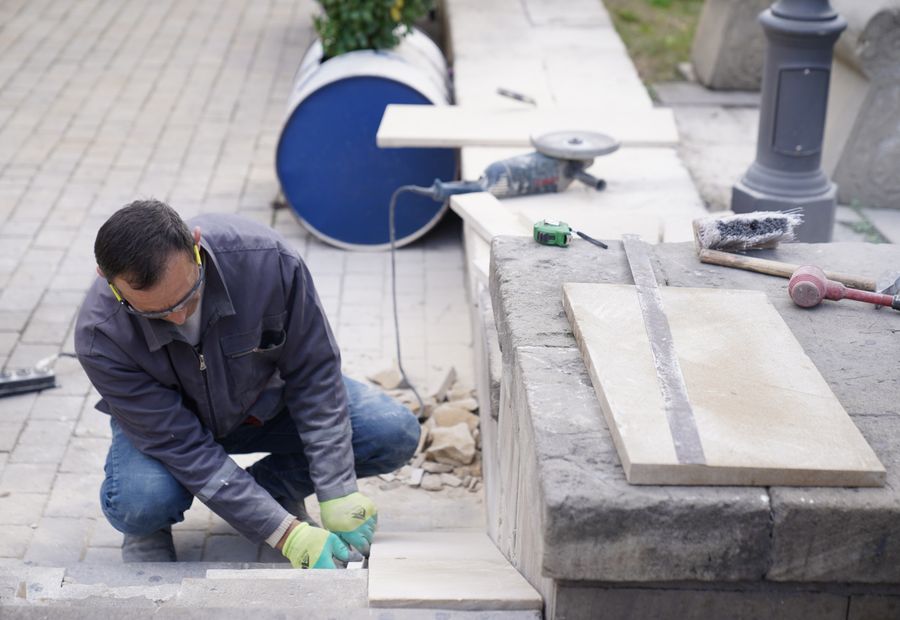
Green Bay Retaining Walls repairs leaning, bulging, cracked, and collapsed retaining walls, and builds the replacements, block runs, timber conversions, boulder walls, drainage corrections, terraces, and commercial walls that go with the work. We serve homeowners, landlords, and property managers in Green Bay, De Pere, Allouez, Bellevue, Howard, Ledgeview, and across Brown County, Wisconsin.
Repairs go back up in Versa-Lok, a solid pinned unit our crew saws on site for curves, steps, and column ends. Washed angular stone fills the space behind the block from the bottom course to the top. Non-woven fabric separates that stone from the red clay, so silt never closes the column. A sleeved perforated pipe lies at the base of the stone and falls to daylight. Taller runs get Tensar UX geogrid between courses in full sheets, at a length taken from the wall height and the soil behind it. The wall we usually arrive to replace was built the other way, with units set on scraped dirt and clay pushed in behind them. Frost drives close to four feet down in Brown County, deeper than most yard walls stand tall, so the freeze takes the whole backfill and lifts it.
Water Is the Load That Grows
Dry soil pushes, and a wall is built for that push. Saturated soil pushes far harder, because the water carries pressure of its own. This county sits on red lacustrine clay, which hangs onto water long after the rain stops. Spring is when the bill comes due. The frost releases, the snowpack melts into ground that cannot take it, and walls that stood all winter go over.
Reading the Damage
A lean means the top rotated out and the base stayed put. A belly means one stretch gave while the ends held. Cracking that steps up through the courses says the ground under the base moved. A dropped toe says the base failed first and everything above it followed.
Reset, Section, or Full Rebuild
Segmental block is concrete, so it does not wear out, and sound units go straight back into the new wall. Your money buys machine time, excavation, base, stone, pipe, grid, and crew, not a pallet yard of fresh block. One bay comes apart and goes back where the rest of the line is straight and draining. The whole run comes down where the base is gone underneath it.
Caps, Bloom, and Outlets
Loose caps lift off, get scraped clean, and go back in fresh adhesive. The white bloom on a block face is efflorescence, salt that water carried out of the concrete, and it stays on the surface. An outlet packed with silt, mulch, or ice shuts the entire drain down, so we find the end of the pipe and open it up.
Booking
One boundary is worth stating. We hold the hill outside your house. A bowing basement wall belongs to a foundation contractor instead. We quote right through the frozen months, then build once the ground opens. (920) 555-0187 reaches a person.
Can a leaning retaining wall be repaired?
It cannot be pushed back upright, and anyone who offers to is selling you the same failure twice. Where the lean is small, sits in one bay, and the base under it is still solid, we take that section down, rebuild the base, put stone and a pipe behind it, and reset the units. Where the wall has bellied in the middle, rolled at the top, or sunk at the bottom, that run gets rebuilt. The test is simple: if the work never opens the back of the wall, whatever caused the movement is still there.
Why is my retaining wall leaning or bulging?
Water is behind almost all of it. Wet soil pushes much harder than dry soil, and Brown County red clay holds water for days. After that, look at what went in behind it. The ones that move have no clean stone behind them, no pipe carrying water off the hill, no compacted base, no course buried at the toe, and no grid on a run tall enough to need it. Anything added above the wall after it went up, such as a parking pad or a shed, finishes the job.
How long does a retaining wall last?
Material sets the ceiling and drainage decides whether you get there. Timber gives you roughly fifteen to twenty years in Wisconsin before the buried wood is gone. Segmental block runs decades. Good stone outlives everybody involved. A wall with dirt packed against its back fails early no matter which of the three it is.
How much does a retaining wall cost per foot?
Pricing goes by face foot, and a face foot counts the buried wall along with the part you look at. Double the height and you more than double the cost. Timber prices lowest, then segmental block, then poured concrete, with natural stone at the top of the range. Height, run length, how much hill has to come out, whether a machine can get to the work, and any load sitting above the wall move the figure. You get a price for your wall instead of an average.